Fan Jiao (焦凡)
The history of early Chinese settlement in Texas differs significantly from that of California. Rather than emerging from the Gold Rush, the first permanent Chinese communities in Texas developed through railroad construction, the growth of cross-border commerce, and the later arrival of a group of Chinese immigrants known as the “Pershing Chinese.” Together, these forces laid the foundation for the establishment of the earliest permanent Chinese communities in Texas.1
1. Central Texas (Calvert, Robertson County) — The Earliest Chinese Settlement in Texas (1870)
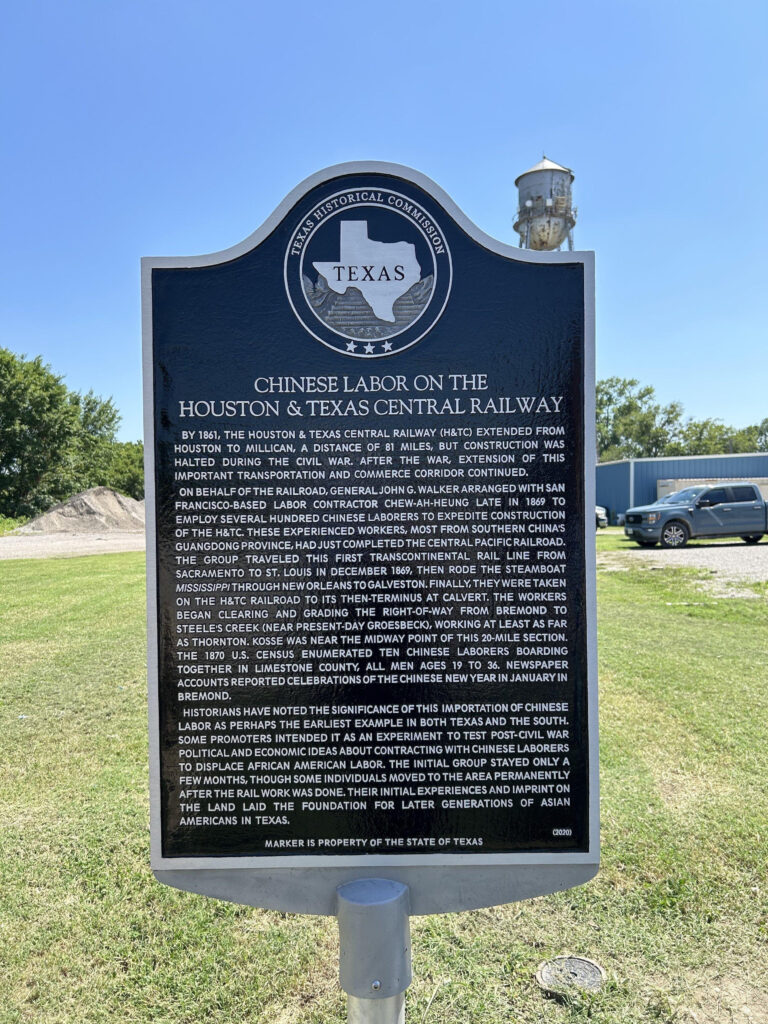
In 1870, approximately 250 Chinese laborers who had previously worked on the construction of the First Transcontinental Railroad came from California to Central Texas. They were hired to build the Houston and Texas Central Railway between Calvert and Dallas. This organized migration marked the arrival of the first group of Chinese railroad workers in Texas and the beginning of the state’s earliest Chinese settlement.
When the railroad project was completed, most of the workers returned to California or moved elsewhere in search of employment. About seventy, however, chose to remain in Calvert and Robertson County, where they engaged in farming, grocery businesses, and other commercial pursuits. Their decision to settle permanently established the first stable Chinese community in Texas and marked the beginning of Chinese American history in the state.
By 1880, the seventy-two Chinese residents of Calvert and Robertson County accounted for 53 percent of the 136 Chinese living in Texas, making the community the largest and most significant Chinese settlement in the state.
A second, much larger group of Chinese railroad workers also arrived from California in 1881 to work for the Southern Pacific Railroad. Of the railroad’s workforce of approximately 3,000 laborers, all but about 400 were Chinese. When construction was completed in 1883, most of these workers left Texas to seek employment elsewhere, but a number chose to remain and settle in the state.
By 1890, the Chinese population of Texas had grown rapidly to 710. Of these, 225 lived in El Paso County, representing 32 percent of the state’s Chinese population. As a result, El Paso surpassed Calvert as the largest Chinese community in Texas and emerged as one of the most important centers of Chinese settlement in the American Southwest.2
2. El Paso — Texas’s First Major Chinese Community (1880s–1920s)
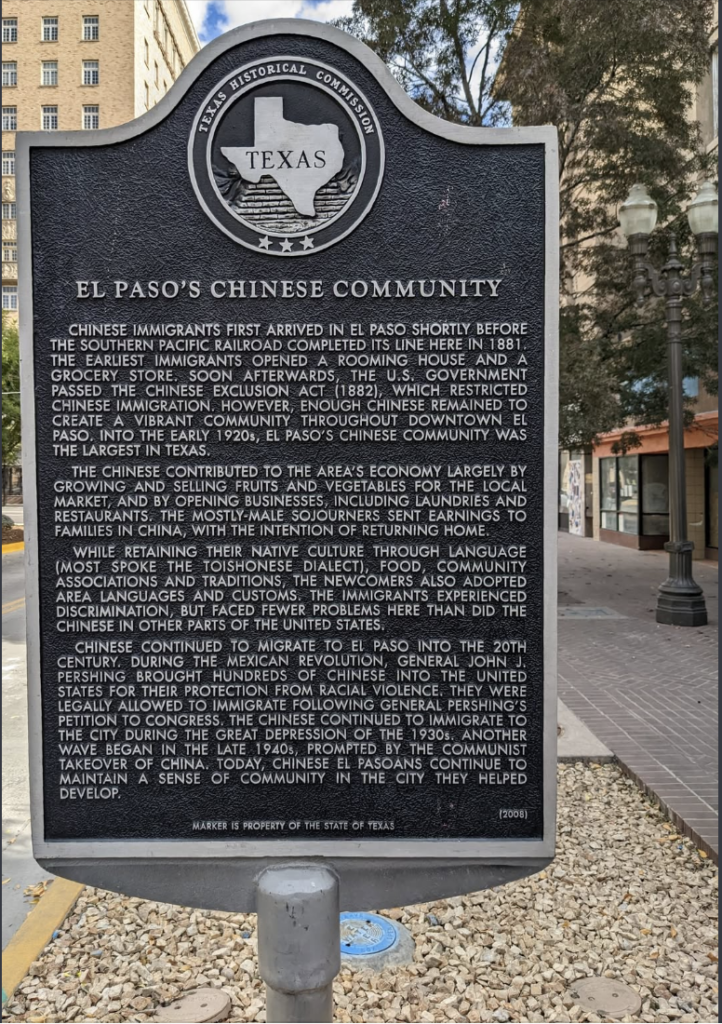
The construction of the Southern Pacific Railroad between 1881 and 1883 brought a large number of Chinese railroad workers to West Texas. After the railroad was completed, many continued on to other projects, but some chose to remain in El Paso, where they established what became the first large Chinese community in Texas.3
Situated on the U.S.–Mexico border, El Paso enjoyed excellent transportation links and a thriving cross-border economy. These advantages attracted increasing numbers of Chinese immigrants, who established laundries, grocery stores, restaurants, hotels, herbal medicine shops, and vegetable farms that supplied local residents and communities along the railroad. By the end of the nineteenth century, El Paso had become the city with the largest Chinese population in Texas and one of the most important centers of Chinese settlement in the American Southwest, earning the nickname “the Chinese Mecca of the Southwest.”
Although the Chinese Exclusion Act severely restricted Chinese immigration, the Chinese community in El Paso continued to grow. Its strategic location on the international border enabled many Chinese merchants to conduct business between the United States and Mexico, while others entered the United States through Mexico. By the early twentieth century, El Paso had developed a well-established Chinatown, together with family associations and mutual-aid organizations that provided housing, employment assistance, and legal support for new arrivals. These institutions made El Paso the social, economic, and cultural center of Chinese life in Texas.
From the 1880s through the 1920s, El Paso remained the most influential Chinese community in Texas. Its rich history is still reflected today in surviving historic buildings, the Chinese section of Concordia Cemetery, and historical markers erected by the Texas Historical Commission, all of which commemorate the enduring contributions of Chinese Texans to the city’s development.
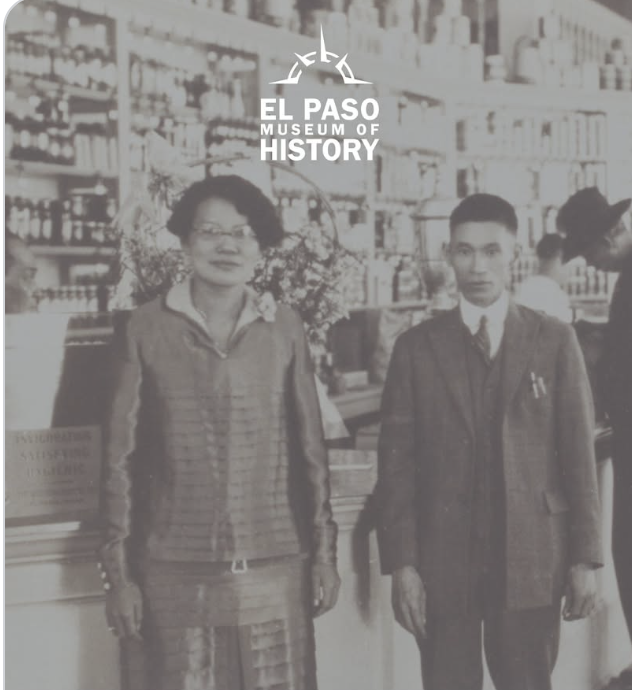
The earliest Chinese residents of El Paso were concentrated along Oregon Street, where the city’s first Chinatown emerged between 1881 and 1882, following the arrival of several major railroads. Many of its residents were former Chinese railroad workers. After construction was completed, some remained employed by the railroad companies, while others established small businesses and laid the foundations of a permanent Chinese community.
Like Chinese immigrants throughout the American West, they largely engaged in occupations that many Euro-American workers were unwilling to perform, particularly the commercial laundry business. Others operated restaurants, grocery stores, and truck farms (small-scale market gardens), or worked as waiters, cooks, and domestic servants. The latter occupations placed them in direct competition with the local Mexican American labor force, occasionally creating economic tensions between the two communities.
Despite living far from their homeland, El Paso’s Chinese residents maintained many traditional Chinese customs and dietary practices. They continued to consume foodstuffs and daily necessities imported from China, and several Chinatown merchants specialized in supplying these goods. Archaeological excavations directed by Dr. Michael Steven Staski have revealed that many of the food and beverage products consumed by Chinatown residents were imported directly from China and stored in Chinese-made ceramic containers. These findings provide valuable material evidence of the community’s enduring cultural ties to its homeland and its determination to preserve traditional ways of life despite living on the American frontier.3
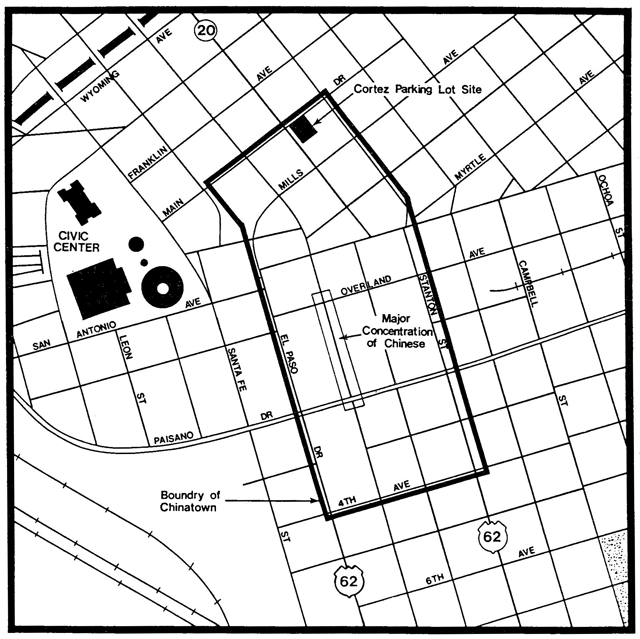
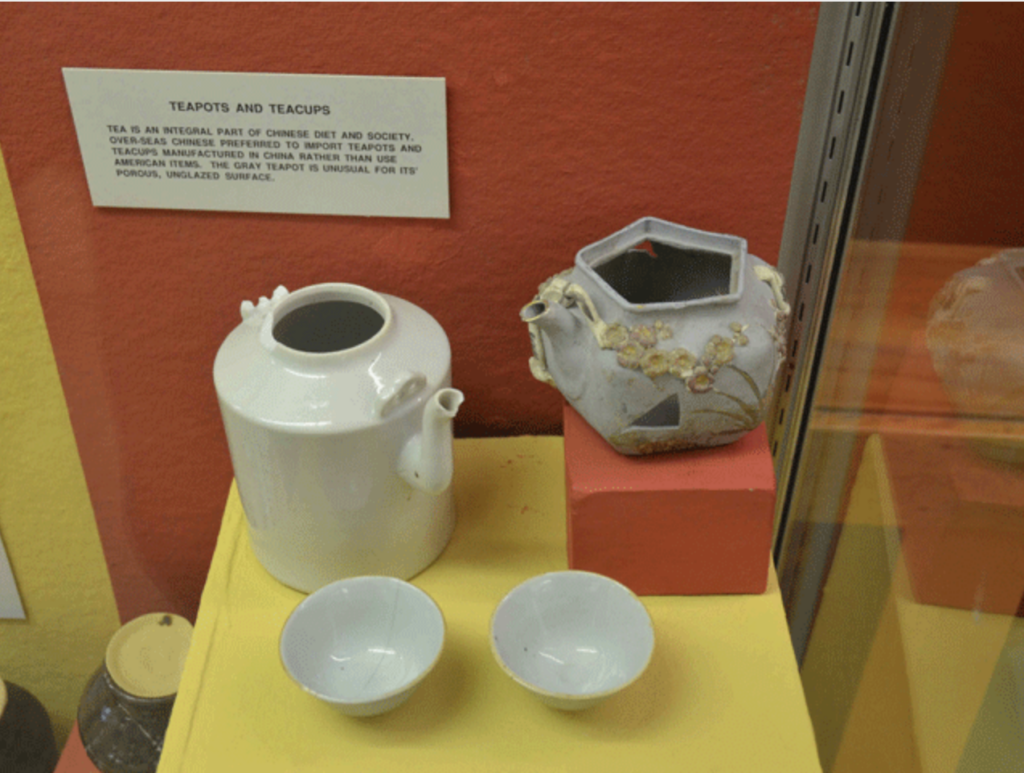
A New Mexico State University study states that for protection as well as social and economic support, traditional Chinese associations called “tongs” formed and confined themselves to Chinatown. The overseas branch of the revolutionary Triad Society (the Chee Kung Tong) became the main institution of the El Paso Chinese community, with almost half of its population belonging to the brotherhood. Faced with racial hostility, the Chinese became more and more independent.
By the end of the 19th century, Mar Wing Kee, a café owner was the unofficial but recognized “mayor” of Chinatown.4
3. San Antonio — Home of the “Pershing Chinese” and Texas’s Largest Chinese Community (1917–1930s)
By 1900, the Chinese population of Texas had reached a historic high of 836. Thereafter, the population began to decline, largely as a delayed consequence of the Chinese Exclusion Act of 1882. Because the Act effectively barred almost all new Chinese immigration to the United States for the next six decades, the Chinese population in Texas gradually diminished through natural attrition rather than replenishment by new arrivals.
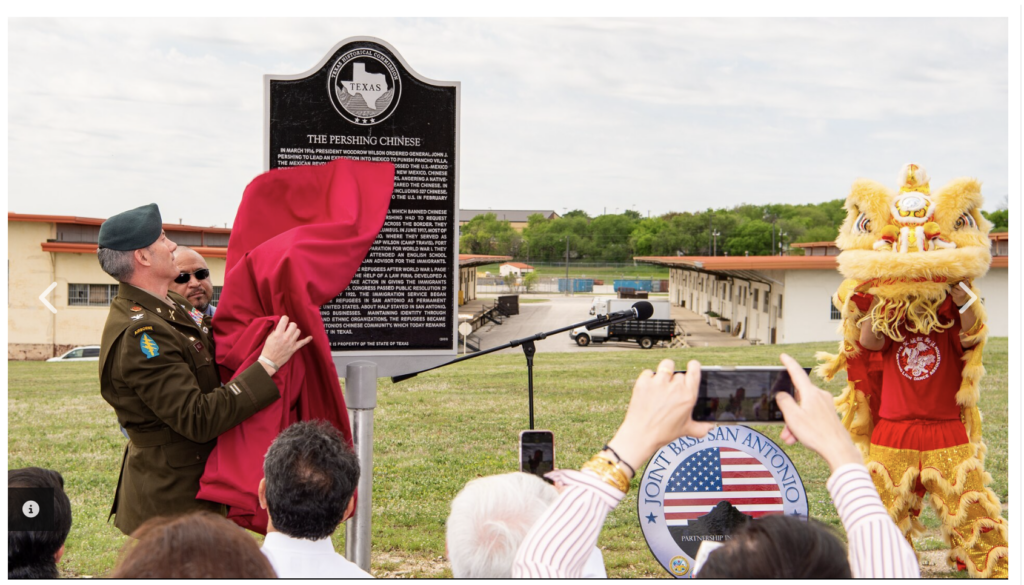
One extraordinary exception temporarily altered this trend. In 1917, following the conclusion of General John J. Pershing’s Punitive Expedition against the Mexican revolutionary leader Francisco “Pancho” Villa, Pershing returned to the United States from Mexico with authorization to bring 527 Chinese refugees who had assisted the U.S. Army during the campaign. These men, later known collectively as the “Pershing Chinese,” represented one of the very few humanitarian exceptions to the Chinese Exclusion Act.
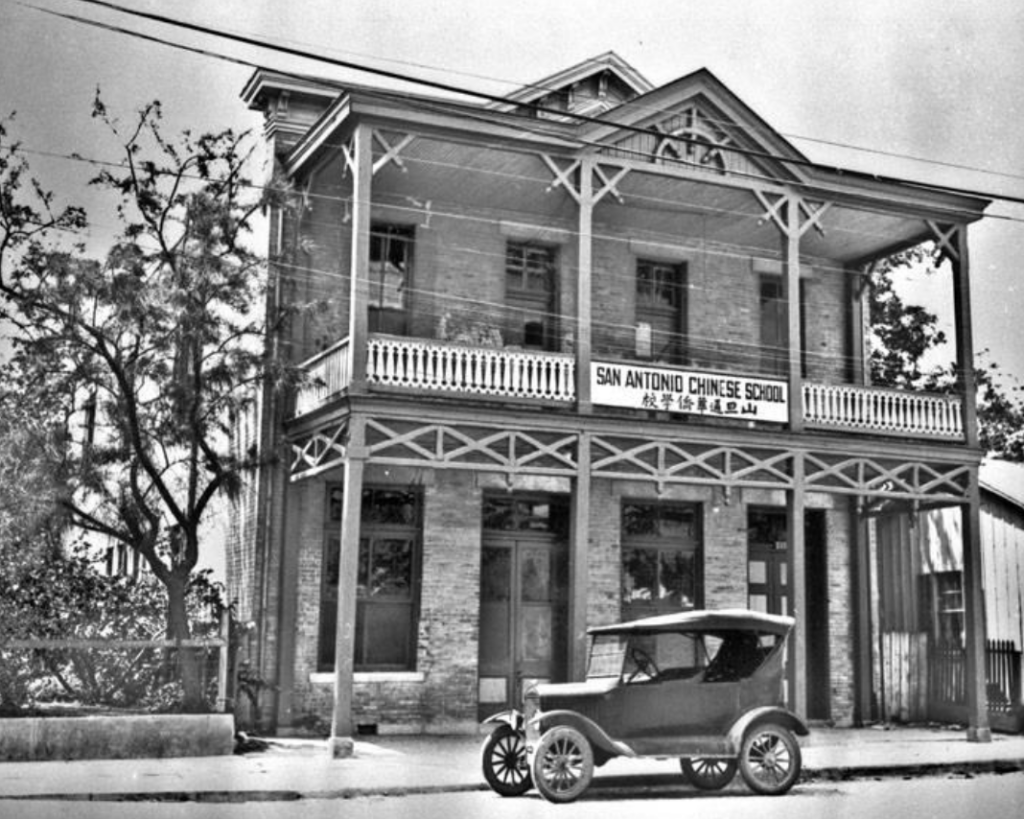
Most of the Pershing Chinese settled in San Antonio, enabling the city to surpass El Paso as the largest Chinese community in Texas. They established Chinese restaurants, grocery stores, and laundries, engaged in the importation of Chinese goods, and gradually built one of the most dynamic and prosperous Chinese communities in the state. Their industry, entrepreneurship, and close-knit mutual support played a pivotal role in reshaping the demographic and economic landscape of Chinese Texas during the early twentieth century.
Although the arrival of the Pershing Chinese revitalized the Chinese community in Texas, it could not fully offset the long-term effects of exclusion. By 1930, the state’s Chinese population had declined to 703, of whom 321 resided in Bexar County, accounting for approximately 46 percent of all Chinese residents in Texas. At that time, San Antonio remained the principal center of Chinese life in the state.
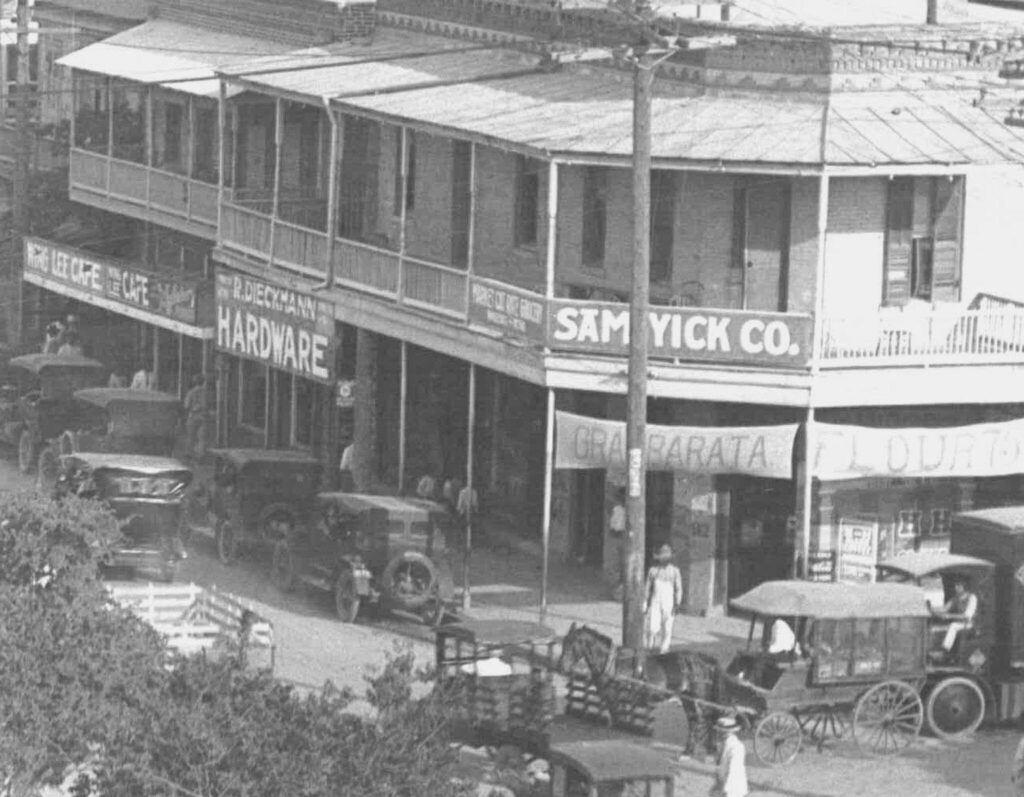
Figure 6, San Antonia market squre 5
4. The Civil Rights Movement of Chinese Texans
The first Chinese immigrants arrived in Texas during the 1870s and 1880s, primarily to work on railroad construction and other forms of manual labor. These pioneers endured not only harsh working conditions but also widespread racial discrimination. Like their counterparts elsewhere in the American West, they were frequently accused of taking jobs away from white workers and became targets of hostility and violence.
One of the most notorious stories associated with anti-Chinese prejudice in Texas involves Judge Roy Bean. According to numerous books and later accounts, after a Chinese laborer was murdered in 1884, the accused killer was brought before Bean. The judge allegedly searched through the law books and declared:
“I find that the law says murder is a crime, but it does not say that killing a Chinese is a crime.”
He then reportedly dismissed the case and released the defendant.
Although historians continue to debate the authenticity of this story, it has endured as a powerful symbol of the anti-Chinese prejudice that permeated parts of Texas during the late nineteenth century.
As elsewhere in Texas, discrimination against Chinese Americans was common in Houston. Yet the city’s Chinese community, which numbered only 50 residents in 1930, gradually expanded as Chinese families relocated from other Southern states. Unlike many parts of the South, Chinese children in Houston were permitted to attend public schools alongside white students. As a result, an increasing number of second-generation Chinese Americans were able to pursue higher education at Texas colleges and universities.
As more American-born Chinese entered the professions and participated in civic affairs, many of the economic and social injustices long endured by the Chinese community began to be challenged and gradually dismantled.
Despite Texas’s relatively small Chinese population compared with California and other western states, anti-Asian sentiment remained deeply rooted throughout the United States during the 1930s. In 1937, a bill was introduced in the Texas Legislature that sought to prohibit so-called “Orientals”—primarily Chinese and Japanese immigrants—from owning urban real estate. The proposal closely resembled the Alien Land Laws that had already been enacted in states such as California, Washington, and Arizona, where they were used to restrict Asians from purchasing, owning, or leasing land.
Although the Chinese Exclusion Act had long barred Chinese immigrants from becoming naturalized U.S. citizens, many Chinese Texans had, through perseverance and hard work, established successful businesses in Houston and other cities. They operated laundries, grocery stores, restaurants, and other enterprises, while purchasing homes and commercial properties that anchored them within their communities. Had the proposed legislation been enacted, it would have jeopardized the property and livelihoods they had spent decades building and could have placed Texas on the same path of legalized discrimination against Asian immigrants that several western states had followed.
Against this backdrop, leaders of the Chinese community—including Edward K. T. Chen and Rose Don Wu—appeared before the Texas Legislature to defend the fundamental property rights and equal treatment of Chinese Texans. Their successful campaign to defeat the proposed legislation marked a watershed in the civil rights history of Chinese Texans. It demonstrated the growing political engagement of the Chinese American community and laid the foundation for broader struggles for equality and civil rights in the decades that followed. 4
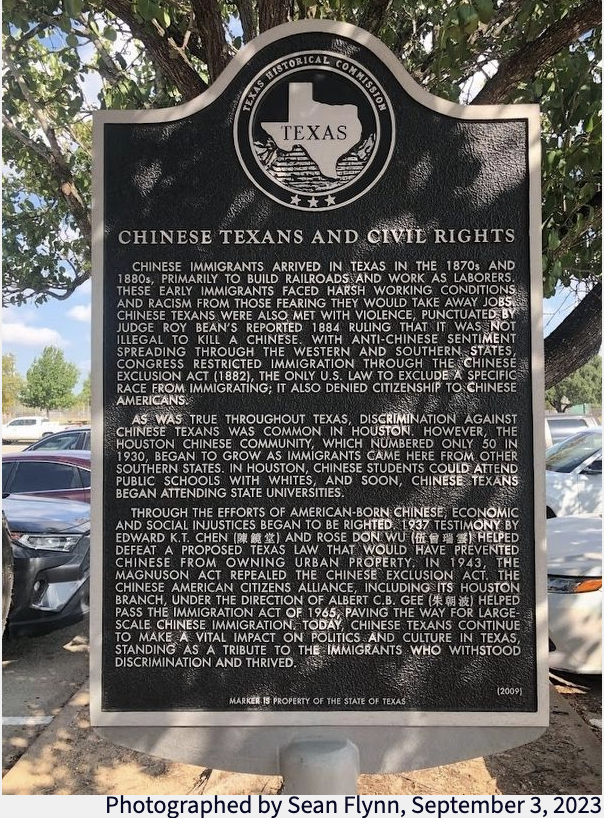
In 1943, the Magnuson Act formally repealed the Chinese Exclusion Act, bringing to an end more than sixty years of exclusion and restoring the eligibility of Chinese immigrants to become naturalized U.S. citizens.
In the years that followed, the Chinese American Citizens Alliance (CACA), including its Houston Lodge, played a leading role in advancing immigration reform. Under the leadership of Albert C. B. Gee and other community leaders, the organization actively advocated for the passage of the Immigration and Nationality Act of 1965. By abolishing the national-origins quota system, this landmark legislation transformed American immigration policy and paved the way for a new wave of Chinese immigration to the United States.
Today, Chinese Texans continue to make significant contributions to the state’s political, economic, cultural, educational, and civic life. Their history reflects an extraordinary journey—from enduring discrimination and exclusion to becoming active participants in the building of modern Texas. Their achievements stand as a lasting tribute to the generations of Chinese pioneers whose perseverance, resilience, and determination enabled them to overcome adversity, earn the respect of their fellow citizens, and leave an enduring legacy for future generations.6
References:
- 水文/Dr.Zhida Song-James,Pershing’s Chinese,https://usdandelion.com/archives/9291, accessed on 7/14/2026
- Edward J.M. Rhoads, updated on September 5, 2022, The History of Chinese Immigration to Texaas, Texas State Historical Association, https://www.tshaonline.org/handbook/entries/chinese, accessed on 7/14/2026
- toh@unm.edu, China Then and Now, Early Chinese life in a Southwestern community: El Paso’s Chinatown, https://www.unm.edu/~toh/china/el-paso.html , accessed on 7/14/2026
- Historical Market Square, San Antonio, https://www.visitsanantonio.com/listing/historic-market-square/2944/, accessed on 7/14/2026
- Borderlands: Chinese Immigrants Helped Build Railroad in El Paso, 2000, EPCC Library, https://epcc.libguides.com/c.php?g=754275&p=5406122%25252523, accessed on 7//14/2026
- The Hon. Dr. Martha J. Wong, Fmr. Texas State Representative & Honoree, https://www.apaics.org/womens-collective-2022/the-hon.-dr.-martha-j.-wong, accessed on 7/14/2026
